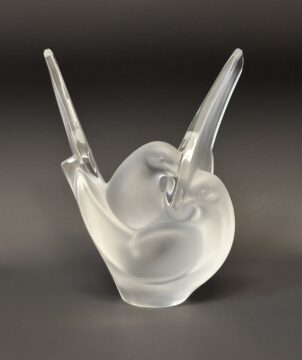
Our June Treasure of the Month features a selection of decorative glassware designed by René Lalique in the early 20th century.
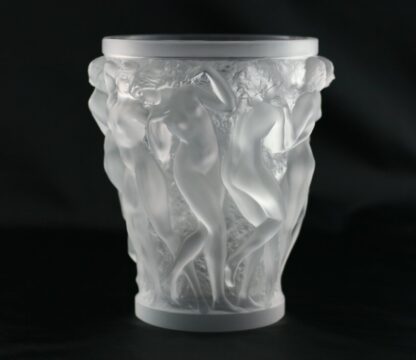
René-Jules Lalique was born in France in 1860. At the age of sixteen, he began an apprenticeship for the well-known Parisian jeweler, Louis Aucoc. After attending the École des Arts Décoratifs in Paris and the Sydenham Art College in London, Lalique began designing jewelry for top French firms such as Cartier and Boucheron.
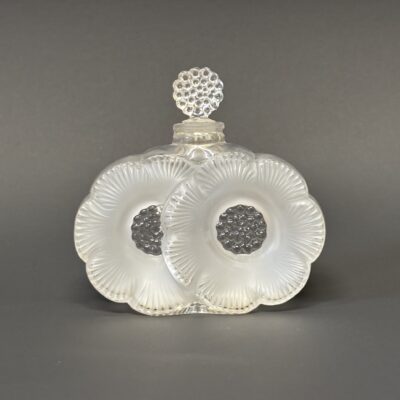
In 1887, Lalique set up his first independent workshop on Rue du Quatre-Septembre. From the beginning, Lalique created unique designs using innovative materials. He combined precious metals and stones with cheaper materials like enamel and glass to create dazzling designs regardless of monetary value. By 1890, Lalique had opened two more workshops and began experimenting with decorative glassware, partnering with a perfumer to create beautiful yet affordable bottles of perfume.
Early in his career, Lalique’s jewelry was recognized for its Art Nouveau style. The Art Nouveau period was characterized by naturalistic motifs and patterns with flowing, curved lines. Nymphs, peacocks, and dragonflies often appeared in Art Nouveau pieces along with various types of flowers and leaves. By the 1920s, the Art Deco style had begun to emerge, and Lalique’s glassware designs reflected this change. Art Deco themes also included natural forms, but these were often highly stylized and geometrically precise.
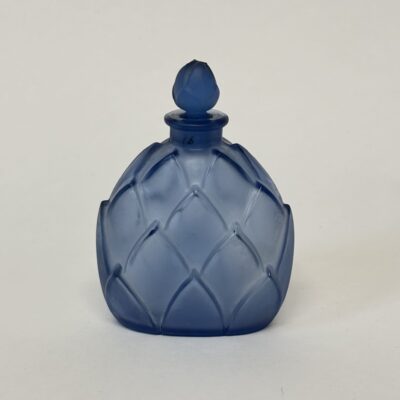
As Lalique moved further into the world of glassware, he took advantage of what were, at the time, the most modern manufacturing techniques available. Lalique utilized assembly lines and reusable molds to manufacture his glass designs by the hundreds, and even the thousands. Despite being machine-manufactured, Lalique’s glass maintained its quality and handmade appearance at a much lower cost, making Lalique glass accessible to the public.
After Lalique’s death in 1945, leadership of the company passed to his son, Marc Lalique, and eventually to his granddaughter, Marie-Claude Lalique. In 2008, a company called Art & Fragrance acquired Lalique, rebranding to Lalique Group. In 2011, Lalique Group opened the Musée Lalique near the company’s factory in Wingen-sur-Moder, France, and in following years has opened multiple Lalique hotels and restaurants throughout France. Lalique continues to produce beautiful jewelry and decorative glass using the same techniques established over 100 years ago.
Why Rosenberg Library?
The Rosenberg Library’s collection of Lalique glassware came from three Galveston donors: Victor H. Neal, a local pianist and music teacher; Douglas Jeter, a social studies teacher and member of the Galveston Historical Society; and Natalie S. Burka, a local leader and activist who co-founded the Annual Used Book Sale for the Friends of Rosenberg Library. Out of the 88 pieces in the museum collection, more than two-thirds were bequeathed to the library by Mr. Neal’s estate.
The Treasure of the Month is located on the library’s historic second floor near the East Entrance. It can be viewed during regular library hours: Monday, Friday, & Saturday, 9:00 am–6:00 pm, and Tuesday–Thursday, 9:00 am–8:00 pm. For museum questions, call 409.763.8854 Ext. 125 or email museum@rosenberg-library.org. For press inquiries, contact the Communications Coordinator.